
About Us
Columbia Students for Justice in Palestine
Est. 2010
OUR NETWORKS:
Columbia Students for Justice in Palestine is a proud component of both the New York City Students for Justice in Palestine (NYC SJP) regional formation, and the National Network of SJP chapters across the so-called U.S. and Canada, facilitated by National SJP.
A Brief history:
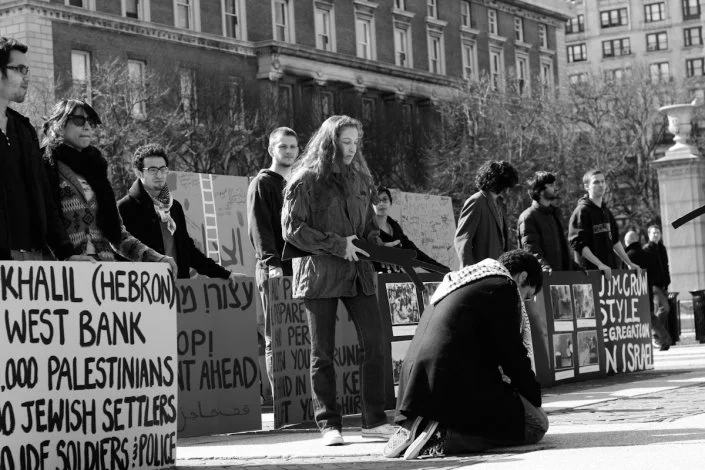
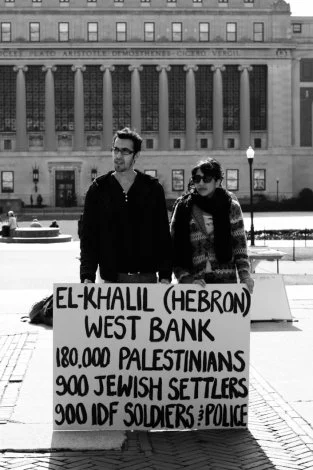
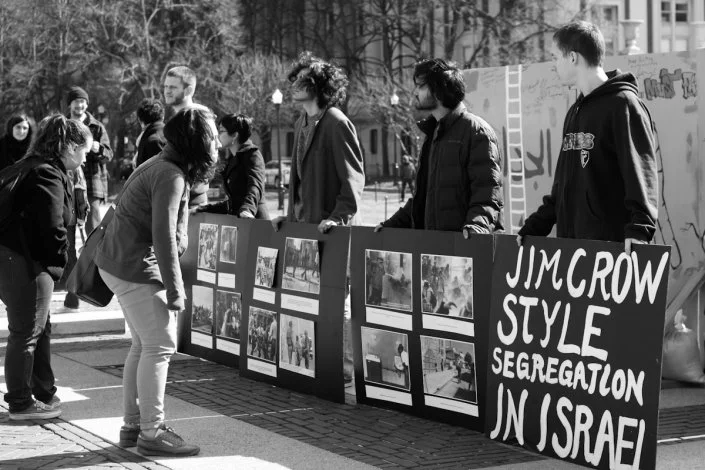
Students for Justice in Palestine at Columbia University is not affiliated with the terrorist, imperialist, Nazi-Zionist, colonizing, gentrifying, pig-loving, genocidal, war-profiteering "institution" known as Columbia University. Columbia SJP became an active organization on campus around March of 2010, following a year of internal efforts and coordination between Arab and Palestinian students across the Columbia and Barnard campuses. Our organization was birthed from a set of demands, publicly published as an open letter on March 2, 2009, and followed by a two-day event challenging Columbia University’s complicity in the colonization and occupation of Palestine.
Approximately one year later, Columbia Students for Justice in Palestine (then abbreviated as C-SJP) was formally inaugurated as a student organization. The original description of our organization was a “diverse group of students, faculty, staff, and community members at Columbia University in the City of New York, organized on democratic principles to promote justice, human rights, liberation, and self-determination for the Palestinian people. We organize around the principles of the Palestinian Civil Society call for Boycott, Divestment and Sanctions of Israel.”
In 2011, Columbia SJP served as the host school for the first National Conference of SJP, held from October 14-16th. The attending chapters of this conference founded National Students for Justice in Palestine (NSJP), a new and independent organization designed specifically to continue facilitating cross-SJP coordination and national convenings to eventually unify the rapidly-growing network of SJP chapters across Turtle Island, or the so-called U.S. and Canada.
The backlash and attempted repression of this convening marked the beginning of Columbia SJP’s direct confrontation with Columbia University administration, eventually translating into multiple confrontations with successive Columbia Presidents and the Board of Trustees.
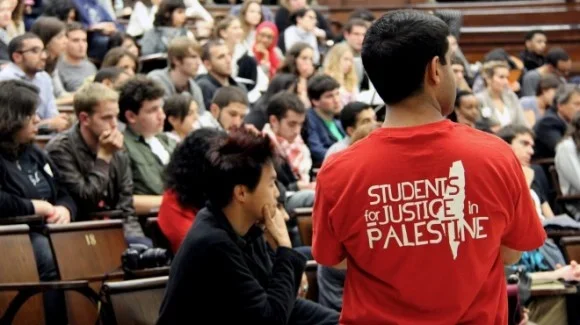
Between 2011 and 2016, our organization underwent a series of re-articulations, eventually leading to our creation of Columbia University Apartheid Divest (CUAD), a coalition formed in 2016 to push forward our referendum for divestment from the Zionist entity, in line with the Boycott, Divestment, and Sanctions (BDS) movement. We modeled this coalition off of the Coalition for a Free South Africa (CFSA), a former Columbia student group that fought for the university’s divestment from South African Apartheid, eventually occupying Hamilton Hall in 1985.
Columbia SJP and CUAD succeeded in this effort: in 2019, the Columbia College Student Council voted in favor of a divestment referendum. Then, in 2020, the referendum itself was also passed by the student body. However, the referendum was overturned by then-President Lee Bollinger.
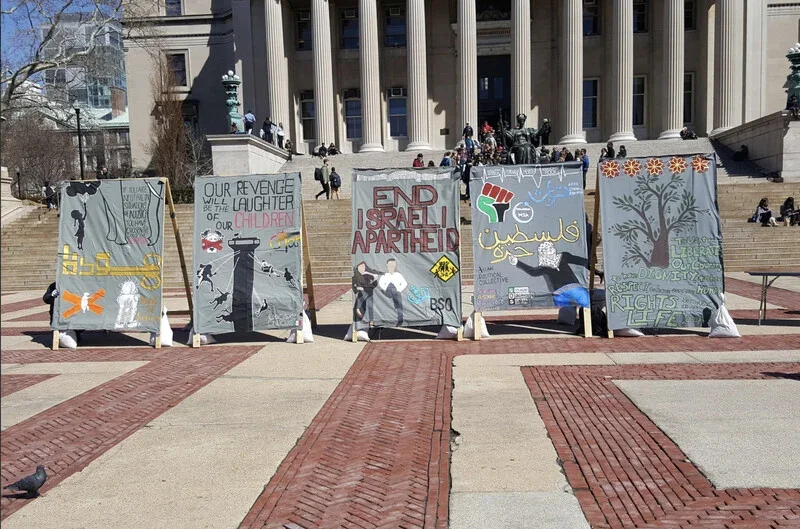
This reversal of over four years of effort from SJP and CUAD led to a period of intense demoralization, and a temporary shift away from direct divestment efforts. Between 2021 and 2023, our organization pivoted to smaller-scale base building and political education. In August, 2023, Columbia SJP was once again reformed, with a new cohort of students and renewed energy behind pursuing divestment.
Just days after SJP’s public return came Operation Al-Aqsa Flood and the beginning of the Zionist-imperialist genocide of the Palestinian people. Columbia SJP and Columbia JVP immediately began the largest and most intensive divestment campaign to date against Columbia University and its complicity.
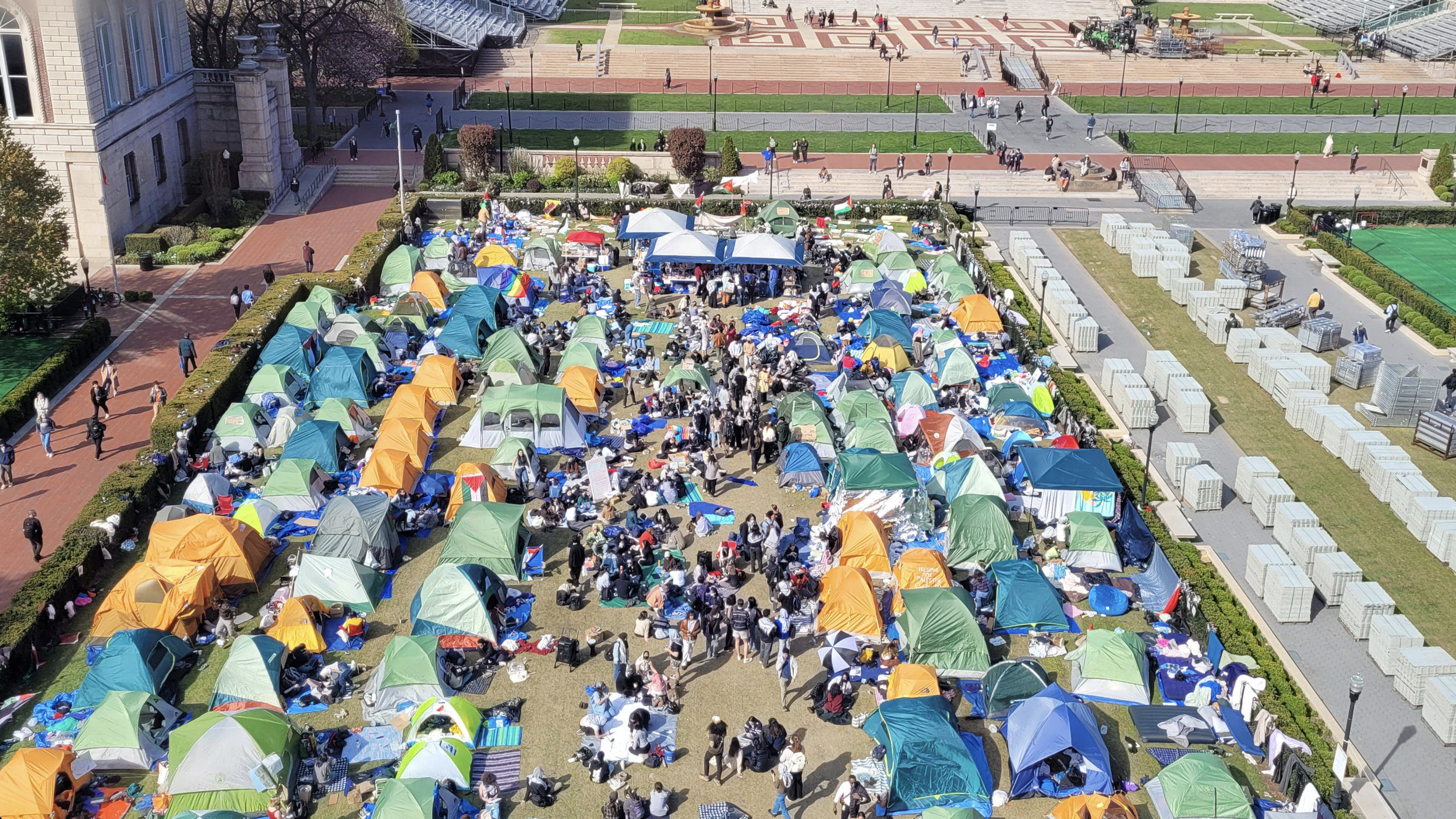
In November of 2023, Columbia SJP (alongside Columbia JVP) was formally suspended as a student organization by Columbia University as an unorthodox and clearly politically-motivated response to our mobilizations. This act led to the resurrection of CUAD, a move supported by over 90 student organizations on campus who joined CUAD’s coalitional structure to protect SJP and JVP while continuing to build momentum for divestment.
CUAD, spearheaded by SJP and several prominent Palestinian and solidarity organizations, worked to build a mass base of thousands of students at Columbia, Barnard, and the semi-affiliated Union Theological Seminary. These efforts culminated in the launch of the first Gaza Solidarity Encampment.
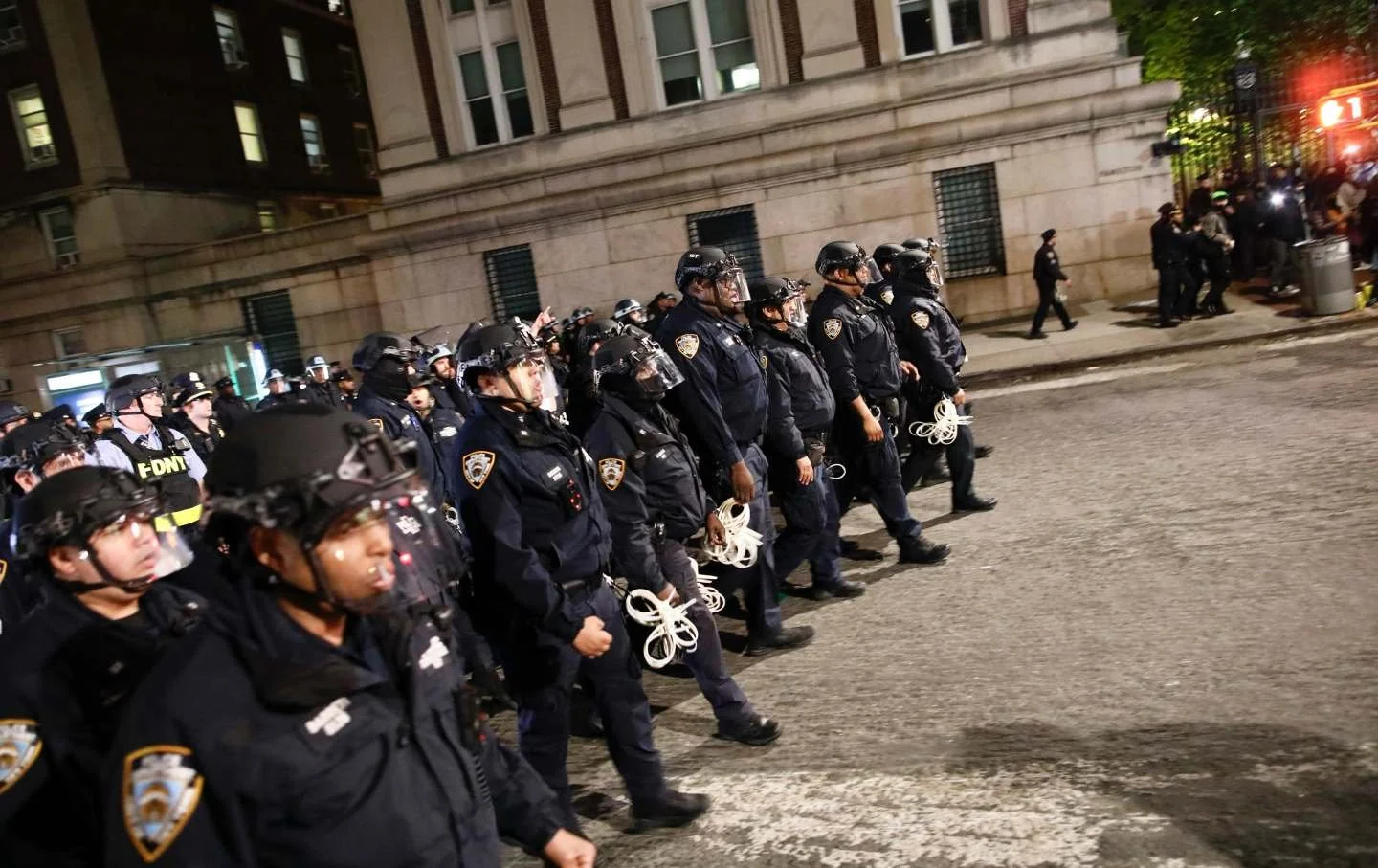
This tactic spread across the country in a matter of days. Even as the first encampment on the South Lawn at Columbia was cleared by the New York Police Department, dozens of other encampments were being launched at universities in solidarity with Columbia SJP and CUAD, fueling the launch of the second Gaza Solidarity Encampment on the North Lawn, and eventually the seizure of Hamilton Hall by autonomous activists, renamed to "Hind's Hall" in honor of Hind Rajab, a five-year-old Palestinian girl murdered by Zionist forces in Gaza.
In the aftermath of the encampments, a majority of organizing and mobilization for Palestine continued under the umbrella of CUAD, now an independent organization delinked from the student organizations that made up the coalition.
The remnants of Columbia SJP played a role in the launch of Revolt for Rafah, a third encampment in May of 2024 that brought together Palestinian students and alumni after the end of the semester. This would be the last public appearance of SJP until the Spring of 2026.
With the slow dissolution of CUAD and the unprecedented suspensions and expulsions of nearly the entire leadership core of the organization came a vacuum on campus. Despite conditions in Gaza worsening and the expansion of Zionist-imperialist war across the region, activity on campus was nonexistent. It is within this vacuum that Columbia SJP was reformulated in the fall of 2025, carrying out public events and actions beginning in January 2026.
OUR PRINCIPLES:
In addition to the principles listed, Columbia SJP upholds the political program of National Students for Justice in Palestine and the political principles democratically ratified by the SJP National Network.
-
The Palestinian right of return is the principle that all Palestinians displaced or expelled from their homes by the Zionist project, between the fall of the Ottoman Empire and the present day, have the right to return to their homes and places of origin, along with their descendants. This principle has been affirmed by international law, particularly the 1948 resolution United Nations General Assembly Resolution 194, which states that refugees wishing to return and live at peace should be permitted to do so. However, we do not rely on international law to judge the legitimacy of our principles. For Palestinians, the right of return is a necessary preliminary step to achieving justice, restitution, and self-determination.
-
The right to resist is the principle that Palestinians and all peoples living under conditions of occupation, displacement, military rule, and national oppression possess the right to struggle for their own self-determination, national liberation, and freedom. International law also recognizes the rights of peoples under colonial domination or foreign occupation to resist these forces. We recognize all forms of resistance as legitimate, including political organizing, labor action, cultural preservation, civil disobedience, international advocacy, and armed struggle. We assert that the Palestinian people and the Palestinian people alone have the right to determine their methods of resistance to the Zionist project.
-
The principle of Palestinian sovereignty holds that the Palestinian people possess an inherent right to govern themselves, exercise authority over their land and resources, and determine their political future, free from external domination or interference. We assert that the Palestinian people have the right to control the entirety of Historic Palestine, the lands between the Jordan River and the Mediterranean Sea. The Palestinian people must exercise control over their own natural resources, political and civil institutions, and determine their own relations with international actors. We reject the version of “sovereignty” outlined in the Oslo Accords of 1993 and 1995; sovereignty and statehood are not synonymous, and we view the creation of the Palestinian Authority as a comprador and an obstacle to the liberatory aims of the Palestinian people.
-
We oppose the global system through which one state, the United States, dominates, exploits, and controls other peoples, territories, and economies using its military, leverage over international bodies and the United Nations, and global economic monopolies. We uphold economic sovereignty and the right of all oppressed peoples to shape their own futures. We believe that unequal global power relations are maintained through military intervention, systems of economic dependency, political coercion, and cultural domination. We uphold that contemporary imperialism is synonymous with the U.S.-led international order, which sustains extensive military deployments, economic sanctions regimes, and political influence across much of the world. We believe that thorough, principled criticism of strong nations in opposition to the U.S. empire, such as Russia and China, should always be allowed, but we reject the theory of multi-imperialism that seeks to downplay or minimize the structural power of the U.S. and its global hegemony.
-
We believe that capitalism, the economic system in which production and social life are organized primarily around private ownership, profit accumulation, and market competition, is the enemy of the people of the world. Capitalism concentrates wealth and power in the hands of a small minority, generates inequality, exploits labor, commodifies essential human needs, and prioritizes profit over social and ecological well-being. We uphold radical visions and proposed alternatives of an anti-capitalist future: democratic control of economic resources, collective ownership, economic planning, or cooperative forms of production. SJP is home to those with a range of ideologies: those who identify with Indigenous Decolonialism, Marxism-Leninism, Maoism, orthodox Marxism, Social Democracy, Anarchism, Socialism, and Third Worldism are all welcome.
-
The principle of freedom from national oppression holds that all peoples and nations have the right to exist, develop, and govern themselves free from political domination, cultural suppression, economic exploitation, or forced assimilation by another nation or state. We oppose systems in which one national group exercises power over another through occupation, discrimination, unequal citizenship, territorial dispossession, or restrictions on language, culture, and political expression. Rooted in the broader principle of self-determination, freedom from national oppression seeks to ensure that all peoples can collectively shape their social, political, and economic futures with dignity, equality, and sovereignty. With our position on occupied land, within an institution actively engaged in displacement and economic warfare against the nationally oppressed groups of New York City, we uphold the right of all groups suffering at the hands of the United States (whether the political entity or the ruling class) to resist their national oppression and achieve national liberation.